SDR FLOW
Powered by NIEOS
Your ICP says who. Your dossier says how. The full-funnel revenue agency that delivers the strategy layer + operational layer + the platform and production in a single integrated engagement. We codify your Playbook into a workflow your team executes, with the strategic artifacts owned by you.
Your ICP scores who to pursue. Your dossier delivers the per-prospect intelligence to engage them. Both layers carry standalone value; together they're Operational ICP: the execution layer between ABM strategy and prospect-level action.
Quantified, scored, evidence-backed targeting that operates at the account level. The ICP decides which accounts to pursue, and which the SDR should never touch. Built from two evidence layers (Strategic Fit + Performance) with customer voice depth and persona affinity scoring. Delivered via the Foundation: a 40+ page board-grade ICP report. Evidence-backed, sourced per claim, with a 90-day operational roadmap.
Standalone value · Built by the Foundation3-page artifact per prospect. Strategic intelligence + engagement plan + MEDDPICC + 3-Layer ICP Fit qualification. ~87 fields. ~6.5 hours of analyst research compressed into a 6-minute SDR review. Companion MEDDPICC intake worksheet operationalizes qualification at the conversation level. Same artifact at every plan tier.
Standalone value · An hour of unguided research becomes a targeted 6-minute review30-45 minutes is an earnest baseline for what an SDR can produce manually. The dossier is closer to a ~6.5 hour analyst brief, compressed into a 6-minute review.
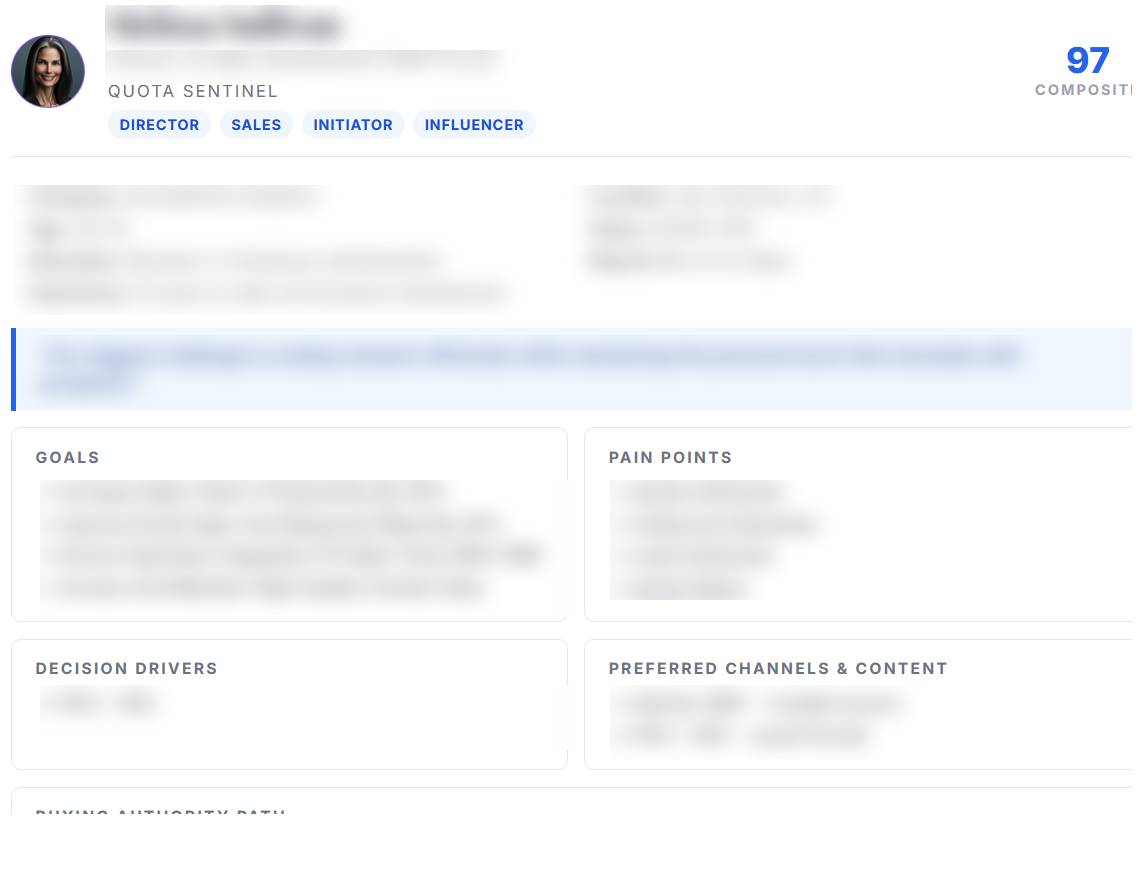
Every dossier is structured for the way SDRs actually work — strategic context, engagement plan, and qualification overlay, in a single print-ready brief grounded in evidence.
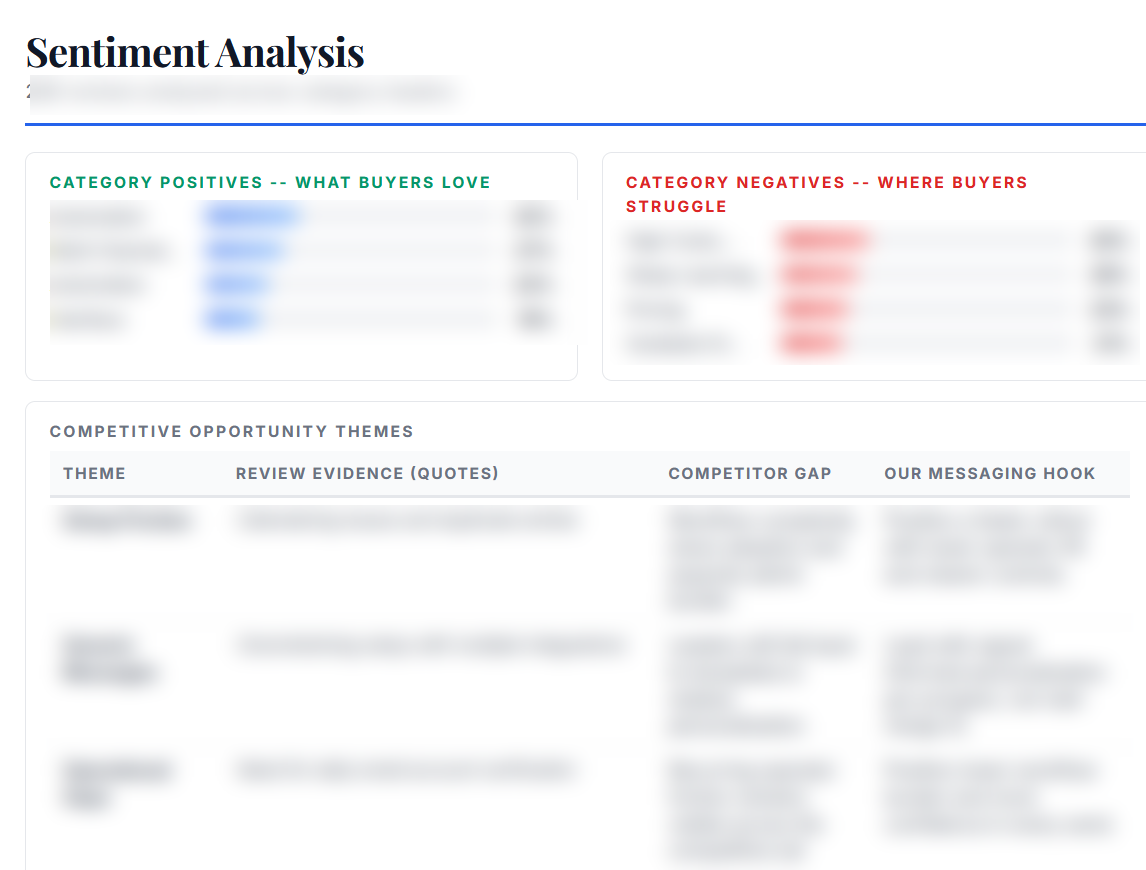
Executive brief, pain & root cause, cost of inaction, product & customer intelligence, industry context.
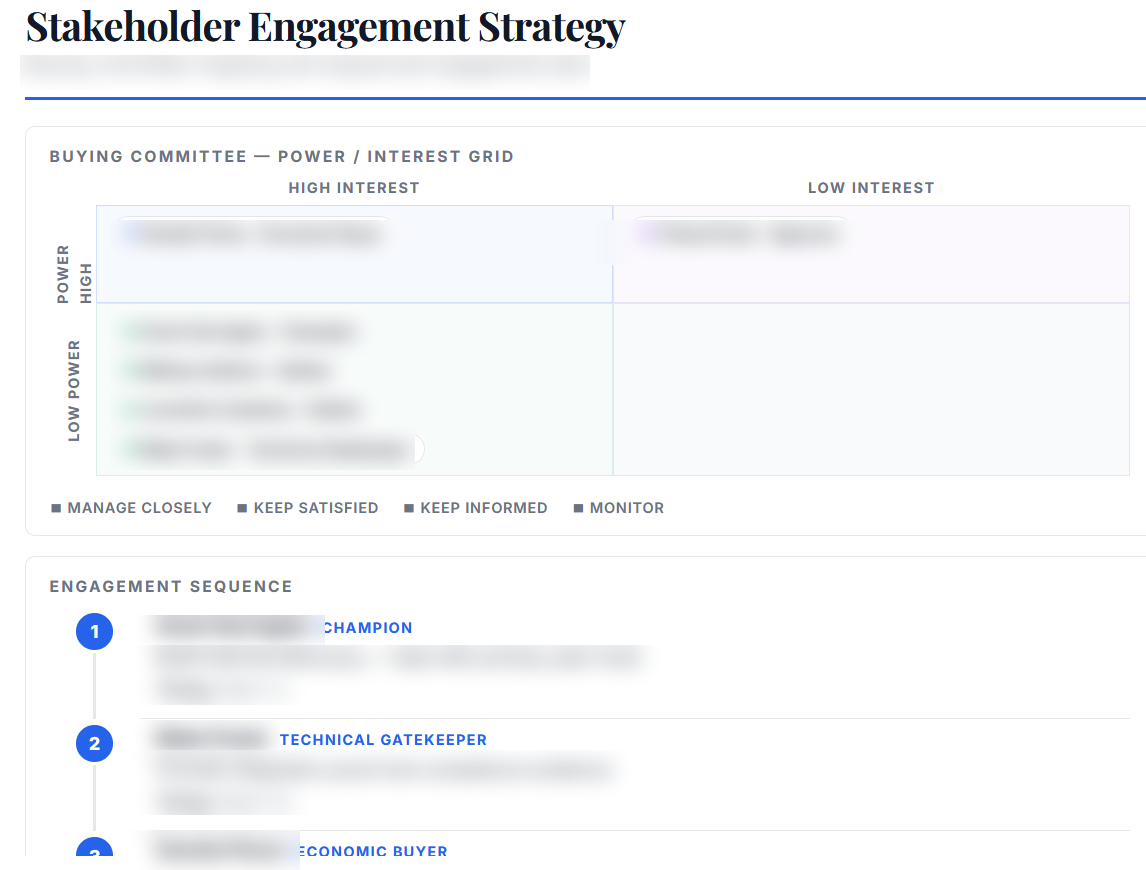
Engagement verdict ring + factor breakdown, 7-card Outreach Synopsis, recommended first touch, role-matched touch sequence with breakthrough touches.
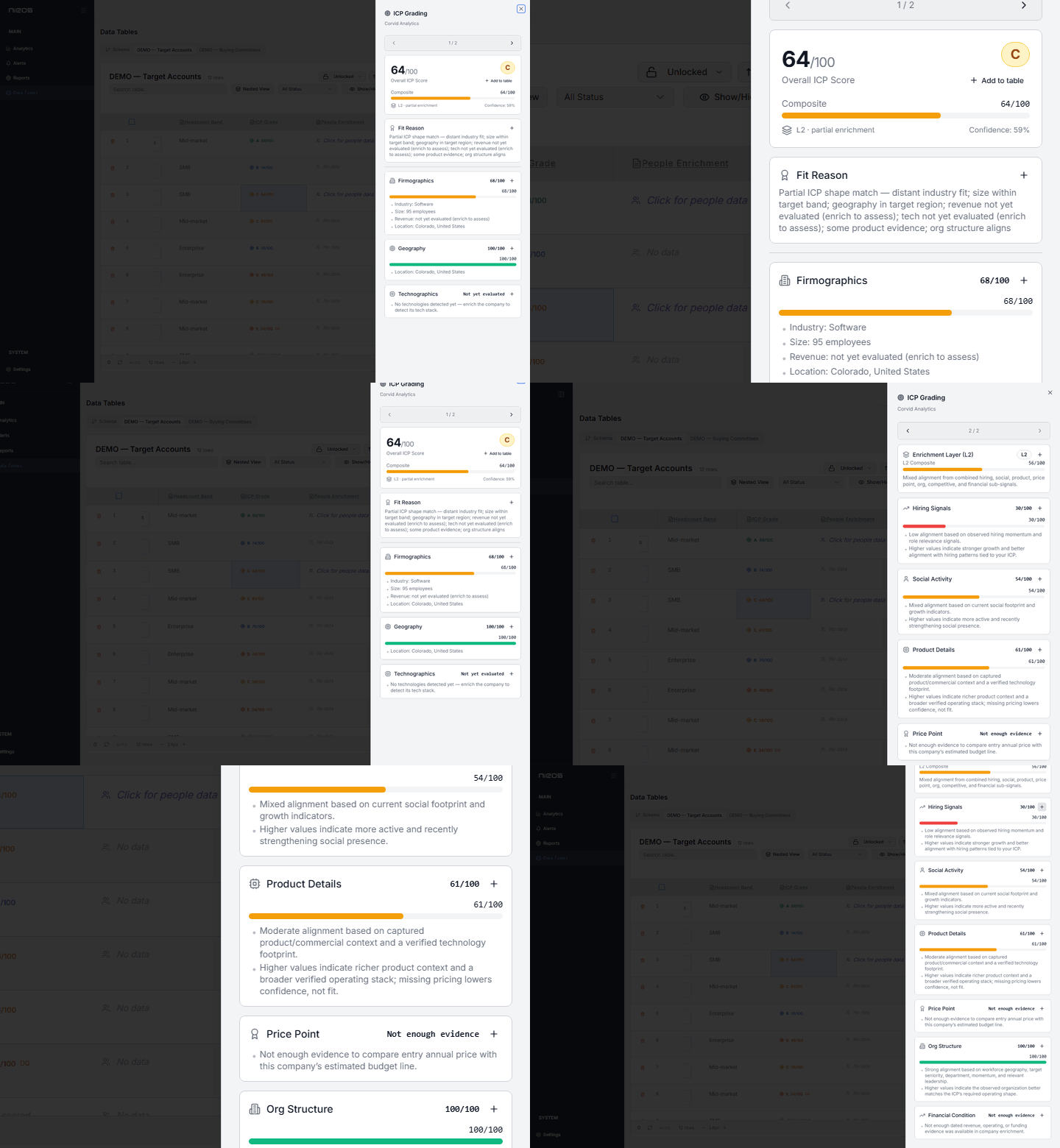
Composite MEDDPICC score + Prospect-vs-Fit (L3) score side-by-side, with Strength / Gap / Action summary, per-dimension cards, evidence trail, and recommended move.
Three foundational frameworks define modern B2B buying.
Analyst-grade is what satisfies them.
Identifies six "buyer jobs" buying groups must complete before purchase: problem identification, solution exploration, requirements building, supplier selection, validation, consensus creation. Sellers win by helping buyers complete these jobs.
Treats the buying committee as the unit of demand, not the lead. Account intelligence must surface the committee, their roles, and the deal dynamics, not just individual contacts.
Identifies six stages of buyer readiness, from latent need through active evaluation to selection. Sellers must match outreach intensity and content depth to readiness stage.
Four reference points. The SDR skim, the AI prospecting baseline (Aomni), the in-house analyst, and SDR Flow. Same dimensions across all four.
| Dimension | SDR Skim~45 min | Aomni~$300/mo | In-house analyst$975–$2,600 / dossier | SDR Flow$250 / Dossier |
|---|---|---|---|---|
| Time to produce | ~45 min manual | ~5 min automated | ~6.5 hrs analyst time | ~15 min engine-produced |
| Depth of intelligence | Website + LinkedIn skim | Thin dossier, lightly enriched | Triangulated, deep, sourced | 16 categories · ~87 fields · triangulated |
| Evidence & provenance | Unstructured notes | Light source links | Full citations | Provenance per claim, confidence scored |
| ICP calibration | None | Generic / basic fit | If wired manually | 3-Layer ICP fit + vector deltas + similarity |
| Qualification overlay (MEDDPICC) | No | No | If analyst trained on it | Per-dimension scoring + evidence |
| Engagement plan | Custom opener | Suggested message | Recommended approach | First touch + sequence + tone + timing + pushback handling |
| Buying-committee logic | No | No | Sometimes | Handled upstream at the ICP/Foundation layer and surfaced into prospect-level qualification |
| Cost-of-inaction analysis | No | No | If scoped in | Root cause → consequence chain, quantified |
| Cost | SDR time only | ~$300/mo (tier-dependent) | $975–$2,600 per dossier | $250 per Dossier (flat) |
| Scale (dossiers / mo per SDR) | ~10–15 (manual cap) | ~50–100 (light output) | ~5–8 (analyst capacity) | 50–100+ (engine-produced, 6-min review) |
| Meets the standard? | No | Partial | Yes, if scoped | Yes, by spec |
Modern B2B buyers self-serve generic information. They want sellers only when context is real and relevant.
The sellers who consistently hit quota treat pre-touch research as a non-negotiable.
| Context Level | What It Contains | Research-Backed Signal | Reasonable Lift | Best Use |
|---|---|---|---|---|
| Generic Outreach | Light template, broad persona/title targeting, little account context | Backlinko: average outreach reply rate is 8.5%, most outreach is ignored | Baseline | Broad market testing only |
| Basic Enriched | Name, title, company, industry, simple trigger, light personalization | Backlinko: personalized subject/body copy improves response by ~+30.5% to +32.7% | +30% to +35% | Scalable outbound where fit is clear but signal depth is moderate |
| Analyst-Grade | ICP fit, role relevance, trigger timing, company context, pain hypothesis, competitive angle, buying-committee logic | Gong: industry, company, individual, and activity-based personalization can create much larger lift | +88% conservative · +200% high-context | Strategic accounts, intent signals, executive outreach, high-ACV outbound |
Most ICP services turn one methodology into a static document. The Foundation builds one targeting framework from two evidence layers: a Strategic Fit Evidence Layer that measures where the product should win, and a Performance Evidence Layer that measures where it has won, activated when usable CRM history exists. This evidence is composed into a rigorous Targeting Framework: who to pursue, how to pursue, and the competitive landscape — with provenance on every claim.
Whether it's your first product or your fifth, the question is the same: who actually buys this, and how do we know? The Foundation answers it the same way at Series A with no CRM as it does at Series D launching a new SKU.
The strategic source of truth. Answers who, why, and how, backed by evidence rather than assertion. Every section traces to source.
The boardroom version of the strategy. Built to defend the ICP in front of a CRO, a CFO, or a buying committee. Not a glossy pitch.
Every account is graded on three layers, with a transparent score and an evidence trail.
Bound to the same ICP definition and tier the scorer assigns. Performance is always measured against the strategy that produced it.
Each asset is triangulated from product truth, buyer-role intelligence, market structure, customer voice, competitive pressure, and GTM research. The rigor is structural, not stylistic.
What buyers praise, what they complain about, which company sizes are satisfied, where competitor products create frustration. So sellers know what to say, and to whom.
Firmographic qualification, TAM viability, buyer-committee logic, need–solution mapping, competitive positioning. Benchmarked against Gartner, McKinsey, Forrester, GTMnow, Census, BEA, and NAICS. So the thesis defends itself in front of a CFO.
Each claim is tested against buyer pain, role relevance, proof strength, customer sentiment, competitor capability, and market validation. So sellers carry claims that hold up under pressure.
Every output traces to a source family: company context, capabilities, pains, value props, USPs, proof anchors, persona intelligence, buyer-decision patterns, customer evidence, competitor intelligence, benchmarks, TAM data, enrichment, and outcomes. So nothing is asserted without provenance.
Foundation tightens who teams pursue, who they ignore, and how they open the conversation.
We turn your customer evidence, role data, and competitive landscape into a quantified, confidence-scored ICP. Every dossier we produce is calibrated to it.
Every plan runs the same Foundation, the same NIEOS GTM Orchestrator, and the same dossier production system. What changes is monthly volume and included users.
Edit the inputs to your own ACV, win rate, SDR loaded cost, and current preparation depth. Productivity, conversion quality, speed, and pipeline value update together.
We will provide a redacted sample during your strategy session along with an ICP example. The Anatomy of a Dossier page describes the structure of a Dossier, while the Foundation page describes the structure of the ICP.
Strong fit: $45,000 ACV+ B2B teams running ABM motions who would prefer their SDRs and sales teams spend more time selling than prepping and researching; teams who need or have a defined ICP but have no concept of how to operationalize it in real time; teams with multiple product lines who need to define targeting; teams that understand the positive relationship between relevance, context depth, and a higher win percentage.
Weak fit: B2C and pure inbound-only motions; B2B teams with no ICP and no intention to start with the Foundation.
Diagnostic Foundation: ~3 weeks. First dossiers ship within ~1–2 weeks of Foundation completion. Pilot teams are typically delivering on real accounts inside the first month.
That’s exactly what the Foundation is for. The methodology is built to handle pre-PMF and re-pivot situations, teams who have a working hypothesis but haven’t formalized scoring criteria, persona models, or signal definitions. If you already had all of that, you’d need a platform, not a Foundation.
The Diagnostic is designed for exactly this case: prove the methodology on your data, get 5 seeded dossiers, decide if the full Foundation is worth it. 100% of the Diagnostic credits toward the Foundation upgrade. See the Pricing tab for details.
We are a full-funnel revenue agency, unique in that we provide the strategy layer, operational layer and the platform in a single integrated engagement. The end result is a comprehensive GTM methodology on semi-autopilot, from strategy to prospect outreach. The NIEOS is the GTM orchestration layer your team uses to operate it.
Most ICP agencies provide a sales deck and then a retainer for advice. We provide the ICP playbook and deck, along with the means for you to operate that ICP via company/prospect level ICP alignment scoring, analytic feedback, and analyst-grade prospect dossiers. Our Operation Plans are priced on the Dossier asset itself, scaled with the needed volume. The orchestration layer is afforded at no additional cost.
Monthly plans run month-to-month after the Foundation is delivered, cancel any time with 30 days’ notice. Annual plans get the discounted rate in exchange for a 12-month term. For operation plans purchased without the Foundation, the minimum commitment is 3 months.
Yes. SDR Flow ingests your existing ICP definition (document, spreadsheet, HubSpot/Salesforce scoring config, or written brief) and calibrates the scorer’s weights to match your fit criteria.
Unused dossiers roll forward for 30 days, up to one month’s plan volume, oldest consumed first. Annual contracts may pool quarterly.
There is a credit tracker and a dashboard that clearly displays how many dossiers have been exhausted and how many remain. Overage or tier upgrades are available when dossiers are exhausted.
If a dossier has missing content in the analysis areas due to error, we will replace it immediately.
Quality is at parity with the leading providers in this category. We multi-source from a curated stack of best-in-class data partners, firmographic, workforce, intent, and contact, and reconcile across them, so coverage and accuracy are stronger than any single-source vendor.
Bring your own data: connect HubSpot or Salesforce, import a CSV, or upload account and contact datasets. Export any of it back out to CSV at any time, with enrichments and ICP scores attached at the row level.
Bring your own keys: AI operations, formulas, and workflows can run on your LLM keys.
Nothing dramatic. Most of it was already yours.
Imported data — yours from the moment you upload it. Exportable any time. No termination needed.
Generated dossiers — saveable as PDF or printable the moment they’re produced. Yours to keep, contract or no contract.
Foundation deliverables — delivered the moment the Foundation is built. The written ICP definition, persona profiles, qualification playbook, and enablement deck are documents you receive, own, and can use anywhere from day one. Unlike platforms that bury your strategic config inside their UI, our deliverables exist as standalone artifacts.
HubSpot & Salesforce: native OAuth connection. Once connected, workflow automations can push contacts, deals, and custom objects from SDR Flow into your CRM and read records back, including SOQL queries against Salesforce. Useful for syncing ICP scores and dossier links onto records, or pulling existing accounts in for scoring.
Webhooks available inside workflow automations for custom downstream integrations.
Hosting: DigitalOcean App Platform (US region) with managed PostgreSQL and managed Valkey/Redis. Encryption at rest and TLS in transit are provided by the managed services. Other regions available on Enterprise scoping.
Compliance posture: the platform is architected for SOC 2 / GDPR-style controls, tenant isolation, audit trails on data access, least-privilege roles, change management on production. We are not currently SOC 2 or ISO 27001 attested. Customers who require a current attestation today should plan for that gap; customers who need it on a roadmap can scope it as part of an Enterprise engagement.
Sub-processors: hosting (DigitalOcean), data and intelligence partners, and AI providers. The current sub-processor list is provided under NDA during procurement review.
Talk to us about your ICP, your motion, and your dossier volume. We'll scope a Foundation, anchor a plan, and show you exactly what the first 50 dossiers will look like.